
The Dictionary God
Notes from an English Learner Who Stopped Worshipping

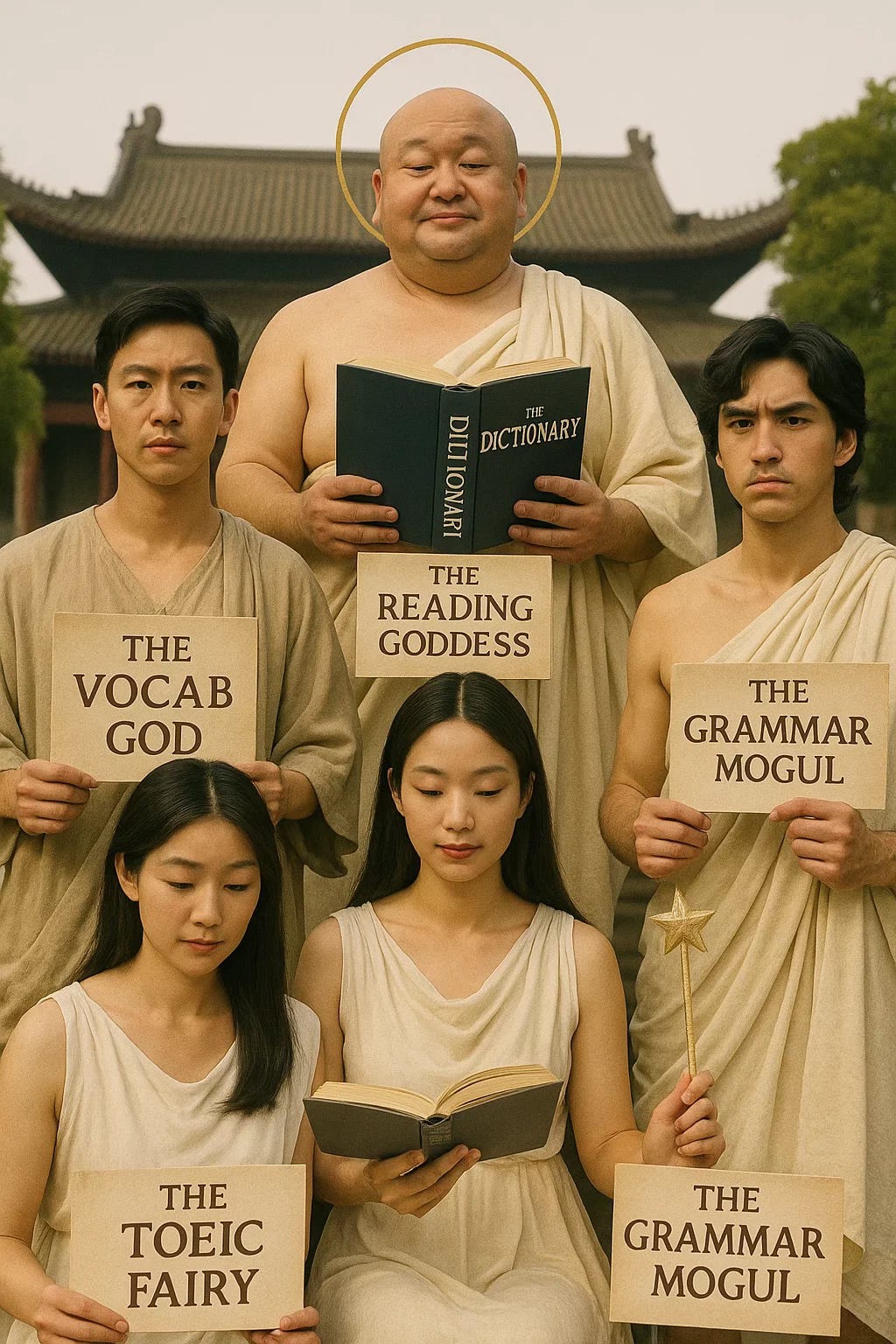
1. The Gods Among Us
We live in a pantheon of English-learning deities. They don’t live on clouds or mountains. They teach in cram schools, appear in textbooks, and smile at us from social media thumbnails. We used to worship at temples. Now we queue outside language institutes.
Like the Ancient Greeks, we name them by their powers:
The Vocab God, who can recite 10,000 words before breakfast.
The Reading Goddess, who glides through TOEFL and GRE passages without blinking.
The TOEIC Fairy, who dispenses perfect scores with a laminated wand.
The Grammar Mogul, who corrects your subjunctive mood before you even speak.
And above them all, The Dictionary God—the one who allegedly memorized the entire Oxford English Dictionary, cover to cover.
Some say he did it twice.
And we believe them.
2. The Scholar Who Never Was
There was a name we all knew: Ku Hung-Ming (Gu Hongming). He was said to have mastered nine languages, earned international acclaim, and recited Shakespeare flawlessly from memory. He read Paradise Lost, understood Goethe's Faust, and translated biblical metaphors with divine fluency.
But here’s the truth:
Most modern readers can’t finish two pages of Paradise Lost without annotations.
Goethe’s Faust—written in early 19th-century German—demands a depth of cultural and philosophical context most learners never encounter.
Even I—an educator, linguist, and writer—would never say I “master” English.
So why do we still believe in him? Because we needed him. In the late Qing Dynasty, when most were illiterate, we needed a miracle. Someone who had conquered the Western tongue. Someone to make us feel less colonized, less behind, less unsure.
He became not a scholar, but a salvation figure.
3. From Curriculum to Cult
It didn’t stop with Ku. Today, we still worship. Not in temples, but in cram schools that look eerily similar. We recite grammar rules like mantras. We carry TOEIC scores like talismans. We memorize vocabulary lists like sutras, believing fluency comes from quantity, not quality.
Cram schools don’t just prepare students. They canonize instructors:
Portraits of legendary teachers hang on the walls.
Their catchphrases are repeated like scripture.
Their study methods become ritual objects.
We no longer ask, “Does this method help me think?” We ask, “Was this how the Dictionary God did it?”
4. The Price of Belief
We forget what language is for. Not for worship. Not for display. But for use. For life. For meaning.
When education becomes ritual, we stop asking questions. When instructors become saints, we stop growing. When language becomes divine, it stops being human.
5. I Stopped Worshipping
I still teach. I still learn. I still read Shakespeare—with annotations, hesitation, and honest struggle. I’ve read Faust in both English and German, and I’ve seen how impossible it is to grasp without help. But I stopped praying to the gods of English. I stopped needing to believe in superhuman feats of memory or mythical prodigies.
Because the truth is quieter than myth. And real mastery is not in how much you memorize. It’s in how much you question.
Watch my full breakdown on the Dictionary God myth here: